How to Learn AI in Nigeria in 2026 (No Coding Required)
You do not need to code to learn AI. This 2026 guide shows beginners in Nigeria how to use ChatGPT, Gemini and Claude properly, write prompts that actually work, speed up daily work, and start earning. Real steps, honest advice, and what it costs.
“How do I learn AI in Nigeria?” has quietly become one of the biggest career questions of the year. Most people assume the answer involves years of maths, Python and a computer science degree. It does not. The AI skills that employers and clients pay for today are used in plain English. You type an instruction, the AI responds. This guide shows a complete beginner, whether you are in Yola, Lagos, Abuja or anywhere else in the country, how to go from curious to genuinely skilled without writing any code.
You do not need to code to learn AI. Focus on three things, in this order. First, get set up on ChatGPT, Gemini and Claude. Second, learn how to write clear prompts. Third, apply AI to real work and services people will pay you for. A focused 5-week course with live mentors is the quickest honest route from zero to earning.
Does learning AI mean I have to code?
There are two very different versions of learning AI. One is building AI systems from the ground up. That is research and engineering work, and yes, it needs heavy maths and coding. The other is using AI, which means operating tools like ChatGPT, Gemini and Claude to get real work done faster. The second version is what most jobs and freelance gigs in Nigeria reward right now, and you can learn it without touching a line of code.
So when a beginner asks how to learn AI, this is usually what they actually want. Here is what that skill set covers.
- Knowing the tools. What ChatGPT, Gemini, Claude and Copilot each do well, and when to reach for each one.
- Prompt engineering. Writing clear instructions with a role, a task, context and a format, so the AI gives you something usable instead of generic filler.
- Productivity. Using AI for emails, reports, spreadsheets, summaries and slides, so work that took hours takes minutes.
- Content and income. Producing copy, visuals, scripts and marketing material you can sell as a service.
- Safe use. Protecting private data, spotting wrong answers, and knowing what you should never paste into an AI.

The three ways Nigerians try to learn AI
Most people start on one of three paths. Here is how they really compare on cost, speed, and whether you finish with a skill you can actually use and sell.
| What matters | Random YouTube & TikTok | Generic 'AI' certificate mills | Syncbright AI Essentials |
|---|---|---|---|
| Structure | Scattered, no clear path | Theory-heavy and dated | Clear 5-week progression |
| Prompt skills | Surface-level tips | Rarely taught properly | Core framework plus practice |
| Hands-on work | You watch, you don't do | Very little | Weekly practical tasks |
| Nigerian context | Mostly US examples | Generic | Local jobs, naira, small businesses |
| Earning path | Vague promises | None | A full week on getting paid |
| Mentorship | None | Pre-recorded only | Live mentors and feedback |
| Cost | Free, but months lost | ₦50k to ₦150k for little value | ₦30,000, instalments available |
There is no shortage of free content. The problem is that beginners never build a repeatable method, never practise on real tasks, and never learn how to turn the skill into money. Structure and a bit of accountability are what close that gap.
“The difference between someone who uses ChatGPT now and then and someone who earns with AI is rarely talent or money. It is a repeatable way of prompting, and the discipline to use it on real work.”
A 5-week plan for learning AI from scratch
Whether you study alone or join a class, this is the order that works. It mirrors the structure we use in AI Essentials. Follow it step by step and you build real ability instead of a pile of random tips.
Week 1: Get set up and comfortable
Start by clearing up what generative AI actually is, without the jargon. Create your accounts on ChatGPT, Gemini, Claude and Copilot, and get used to moving between them. You also look at how Nigerian freelancers and small businesses are already using these tools to win work far beyond their own city.
Week 2: Learn to write prompts that work
This is the week that matters most. You learn a simple framework for prompts that covers the role you want the AI to play, the task, the context it needs, and the format of the answer. You practise holding a back-and-forth conversation instead of asking one-off questions, and you learn how to stop the AI from giving vague or wrong answers. By the end you have a set of prompts built around your own line of work.
Week 3: Use AI to do more in less time
Now you put it to work. Draft and summarise emails, pull insights out of Excel and Google Sheets without writing formulas by hand, turn long meetings into clear notes and action points, and build the first draft of a presentation in minutes. This is where AI stops being a toy and starts saving you real hours.
Week 4: Turn AI skills into income
Here you learn to get paid. Write sales copy, articles and social posts that read like a human wrote them. Create clean graphics and marketing visuals. Try basic AI video and voiceover. Most importantly, you learn how to package all of this into services you can sell on Upwork, Fiverr and to businesses around you.
Week 5: Use AI safely and build the habit
You finish with the professional side. What you must never paste into an AI, how to spot fake images and biased answers, and how to fold these tools into your daily routine for good. You round it off with a project, such as a full marketing campaign or a business proposal built using only AI tools, and earn a certificate you can verify.
What do you actually need to get started?
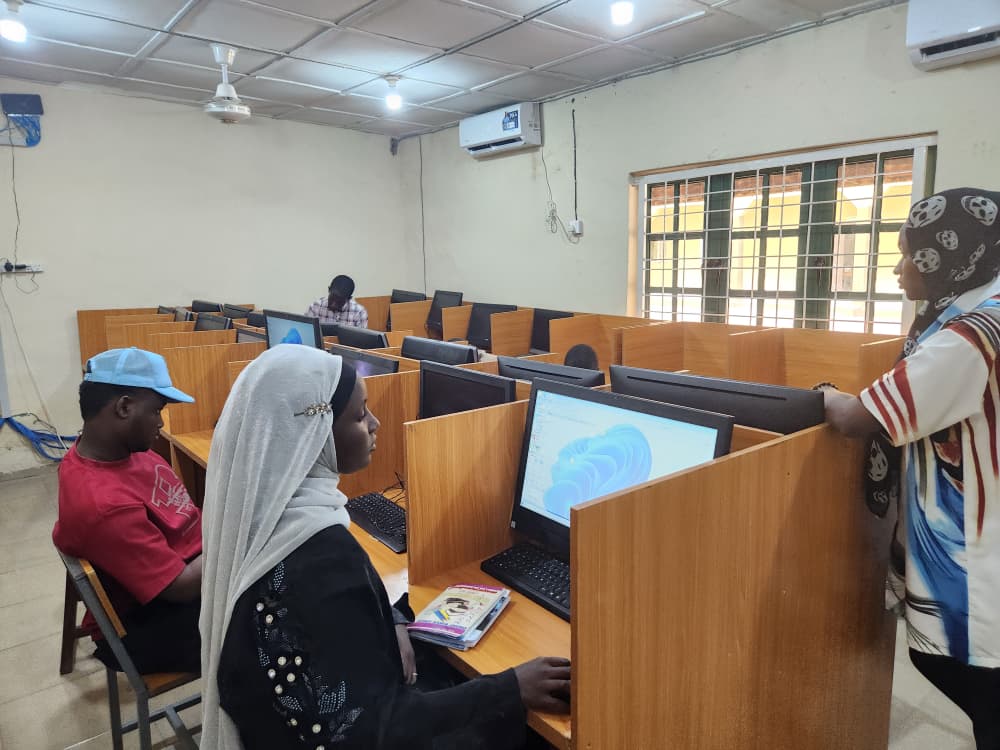
People assume AI needs a powerful computer. For the no-code work covered here, that is not true. Almost everything runs inside a browser tab.
A basic laptop, or even a phone, with a modern browser and a steady internet connection is enough to begin. The free versions of ChatGPT, Gemini and Claude are plenty while you learn. You only think about paid plans once the skill is already earning for you.
How do beginners actually earn with AI in Nigeria?
Once your prompting is solid, a few income paths open up quickly, often in weeks rather than years.
- Writing. Blog posts, product descriptions, email campaigns and social content for brands and small businesses.
- Visuals. Marketing graphics, flyers and ad creatives made and refined with AI design tools.
- Data and admin. Cleaning up spreadsheets, building reports and automating repetitive office tasks.
- Freelancing. Packaging AI content or automation as gigs on Upwork and Fiverr, where demand keeps rising.
- Local business help. Setting up AI replies and content systems for shops, schools and startups near you.
A single content or automation job for a Nigerian business can pay between ₦30,000 and ₦100,000, so the cost of good training often comes back after your first or second client.
The honest truth about AI and your career
We tell every student the same thing. AI will not make you money while you sleep, and five weeks of learning is a starting point, not a jackpot. What AI does is make whatever skill you already have go further. Learn to prompt well, use it every day, and pair it with real work in writing, design, business or development, and you become far more productive and far more employable than people who ignore it.
If you already code, or you want to, combining AI with web development is a strong move. Have a look at our guide to the top in-demand tech skills in Nigeria, and think about moving from AI Essentials into Frontend or Full Stack Development once you are comfortable.
Learn AI the practical way
Join the next AI Essentials cohort at Syncbright Technologies. It is fully online, no code required, with live mentoring and a whole week on how to earn. ₦30,000, with instalments available. Got questions? Message us on WhatsApp at 07078686782.
See the AI Essentials syllabusWritten by Syncbright Technical Team
Syncbright Technologies is a CAC-registered tech company in Yola, Adamawa State. We engineer high-performance web applications and digital systems for clients, while mentoring the next wave of Nigerian software developers through practical, project-based cohorts.